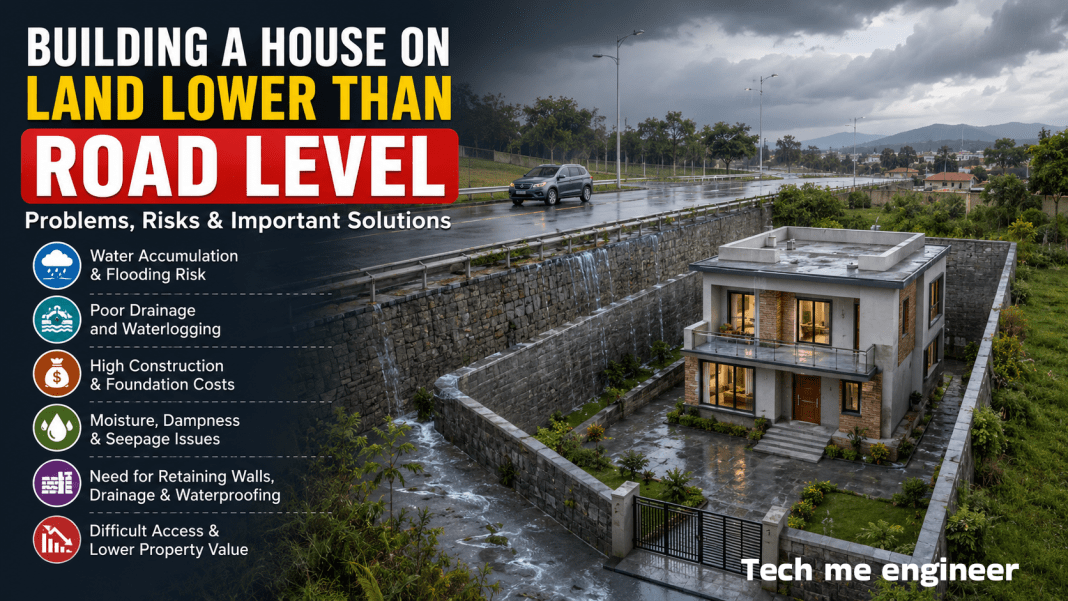

Building a House on Land Lower Than Road Level is most important to all homeowners. Most people have one big dream: to buy a new plot and built a new own house. But one thing: you do not buy new land lower than road level. Land seems like a good way to save money because this type of land is at a low price compared to uper level of land over road level. But no, if you build a New house on this type of plot, it automatically increse a Builing cost.
Also, if you want to build a structurally safe house, you have to work on a proper engineering plan and design carefully. Otherwise, you don’t make a safe house economically. So today we will discuss land below road level in detail.
The following are the Most common disadvantages:
Water Can Enter the House Easily
Water always flows from the upper level to the lower level in the terrain. In this case, we have a plot below the road level, so water flows from the road level to the land filled by heavy rainfall, and it can enter the house easily. This is one of the most common disadvantages for the landowner. So you have to proper drainage system to channelize water. Even a small amount of water can damage your house flooring, painting, plumbing, sanitary, electrical, and furniture and other Property. If the land is located in a high monsoon area, this is a greater concern.
Poor Drainage Around the House
In the case of Nepal, most of the drainage systems supply from the road level or road alignment. I hope you already know about this. But it is difficult to build a house with a proper drainage system on land below the road level. Proper drainage is most important for all buildings. The major issue without proper drainage, a low-level land house.
Standing water
Muddy surroundings
Waterlogged gardens
Mosquito breeding
Bad odors
Higher Foundation Construction Costs
In the initial phase, most of the people buy a plot in chipper price of land below the road level. Compared to other land, this type of land is low-priced. And after purchase of this type of land, it automatically increases building foundation costs. Normally, the residential house foundation depth is 5 to 7 ft for a 2- to 3.5-story building. But the land below a road level requires a higher depth it’s automatic increse foundation cost of the building.
In this condition, if most of the building rises above a road level, you may need :
Large quantities of soil filling
Retaining walls
Additional compaction
More concrete
Extra excavation
Moisture and Dampness Problems
This is a normal issue with the building. In the case of Nepal, around 80% of buildings have seepage, leakage, and dampness issues. No matter how much of a defect in the house, this issue normally causes seepage and dampness to arise.
Moisture (Seepage, leakage, and Dampness) is one of the biggest enemies of any building. In the lower-level land from the road level, more water is collected, and an automatic increase in groundwater and moisture easily transfers into the house.
If moisture enters the house, common visible symptoms:
Peeling paint
Damp walls
Mold growth
Unpleasant smell
Damaged wooden furniture
Proper waterproofing becomes essential when building a house on land lower than road level.
Increased Pressure on Retaining Walls
If you build a house on land lower than road level, retaining walls are very important to protect the upper land from sliding and protect the road from the landslide. These walls are constructed to protect the higher ground surrounding your property and prevent soil from sliding into your plot area.
Resisting the weight of soil (lateral earth pressure) and groundwater-trapped pressure is a big challenge.
In the rainy season, more water is collected behind the wall if no proper drainage system is installed.
This additional hydrostatic pressure can be even more dangerous than the soil itself, significantly increasing the risk of structural failure.
If the homeowner notices the following warning signs:
- Horizontal or vertical cracks
- Bulging or leaning walls
- Separation between the wall and the ground
- Soil erosion behind the wall
- Water leaking through cracks
- Uneven settlement near the foundation
Difficult Access to the Property
Access becomes another challenge; the land is below the road level. If the road is higher than the land, you can’t walk or drive directly to the house. Accessibility should always be considered before purchasing such land. You need a proper ramp or stair house below road level; usually requires:
• Long staircases
• Ramps
• Steep driveways
This becomes inconvenient for:
• Elderly family members
• Children
• Wheelchair users
• Vehicle parking
Sewerage and Wastewater Problems
Another major disadvantage of building a house on land lower than road level. It is the same as a drainage issue. Sewage systems depend on gravity. It is very challenging to manage sewerage and wastewater to the drainage. Most homeowners focus on the building foundation and drainage, but they don’t focus on managing sewerage and wastewater produced from bathrooms, the kitchen, and the terrace of the house. If your house sits lower than the public drainage line, wastewater may not flow properly. In many cases, homeowners must install sewage lifting pumps, adding both installation and maintenance costs.
As a result, homeowners may experience several problems, including:
- Slow-draining sinks, bathrooms, and kitchen floors.
- Frequent blockage in sewer pipes.
- Overflowing inspection chambers during heavy rainfall.
- Unpleasant odors around the house.
- Backflow of dirty water into toilets or bathrooms.
- Increased risk of contamination and health hazards.
Reduced Property Market Value
In my case, I don’t like land below the road level. Such case follows the, most people do not want to buy this type of land easily. So automatic reduce the market value of the property. Most of the clients focus on location and elevation. Many buyers prefer plots that are equal to or higher than road level.
Several factors can reduce the resale value of such a property, including:
- Concerns about flooding during the rainy season.
- Higher maintenance and waterproofing costs.
- Expensive retaining walls and drainage systems.
- Difficult vehicle and pedestrian access.
- Possible sewerage and wastewater issues.
Continuous Maintenance Expenses
All the above problems don’t end after building construction. Like drainage issues, sewerage management, difficult access, water pressure, etc. This is a long-term disadvantage for the house owner. Ongoing maintenance is required for the long term. Homes below road level usually require ongoing maintenance such as:
- Cleaning stormwater drains and surface channels to prevent blockages.
- Repairing waterproofing membranes on foundations and basement walls.
- Removing mold and mildew caused by excess moisture.
- Sealing cracks in retaining walls, boundary walls, and concrete surfaces.
- Servicing sump pumps and sewage lifting pumps.
- Maintaining retaining wall drainage systems and weep holes.
- Repainting damp or water-damaged interior and exterior walls.
Future Road Raising Can Make the Situation Worse
One hidden risk many homeowners ignore is future road development. Local authorities may raise the road level during future upgrades. If your house is already lower than the road, future road construction may make it even lower.
This can lead to:
• Increased flooding
• Poor visibility
• Difficult driveway access
• More water entering the property
Planning for future road improvements is just as important as planning your house itself
Can You Still Build on Low-Level Land?
Answer: Yes.
Building a house on land lower than road level is possible if the project is properly engineered.
Experienced civil engineers typically recommend:
• Raising the plinth level
• Installing effective stormwater drainage
• Compacting filled soil properly
• Using retaining walls where necessary
• Applying high-quality waterproofing
• Designing proper surface slopes
• Installing sump pits and pumps if required
Tips Before Buying a Low-Level Plot
Before purchasing any plot below road level:
• Measure the height difference accurately.
• Check nearby drainage conditions during the rainy season.
• Ask neighbors about flooding history.
• Estimate filling and retaining wall costs.
• Consult a qualified civil engineer.
• Verify future municipal road development plans.
• Budget for waterproofing and drainage systems.
Yes, but only if the house has proper drainage, waterproofing, and a raised foundation. Good planning can reduce most risks.
Yes. You may need extra soil filling, retaining walls, waterproofing, and drainage systems, which increase construction costs.
It can if water is not managed properly. A good drainage system and a higher plinth level help prevent flooding.
In many cases, yes. Buyers often prefer houses that are at the same level as or higher than the road.
Check the height difference from the road, inspect the site during the rainy season, and consult a civil engineer before buying.