
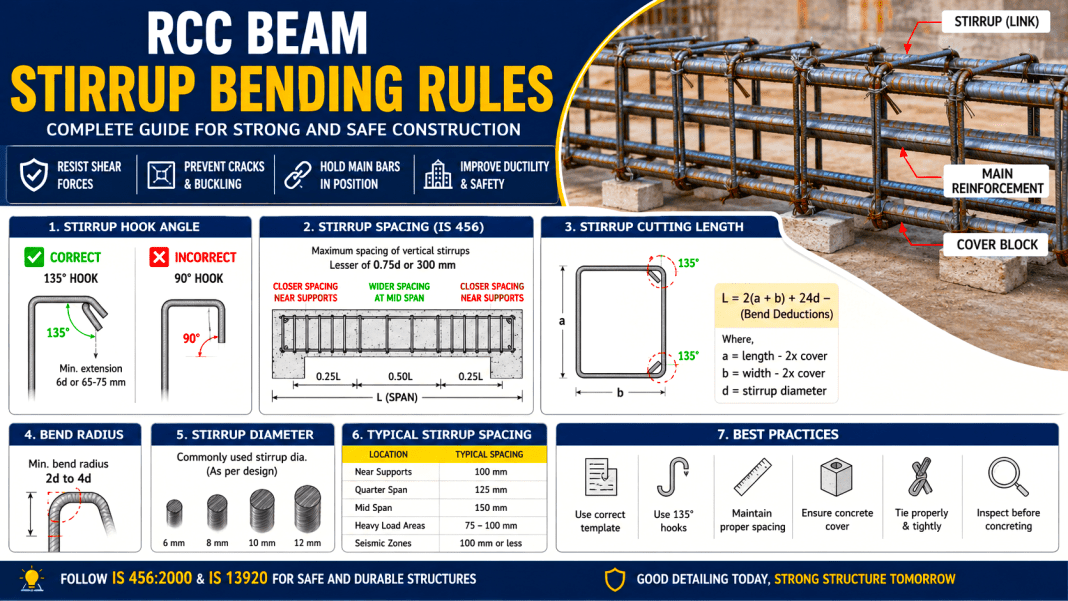

I hope this is a very important topic for all engineers, supervisors, contractors, architects, and all construction professionals. RCC Beam stirrup Bending rules for strong construction. In the market, most of the people are focused on just the main bar, but stirrups and ties are also crucial in construction.
Even if the main bars are strong, incorrect stirrup bending or spacing can significantly reduce the beam’s strength.
Stirrups are used to resist shear force, hold the main bar in position, and enhance the overall stability of the concrete beam. If they are bent incorrectly or installed with improper spacing, the beam may develop diagonal cracks, excessive deflection, or even fail under heavy loads.
In this guide, you’ll learn the correct RCC Beam Stirrup Bending Rules, recommended hook angles, spacing requirements, cutting length calculations, common site mistakes, and practical tips based on real construction experience. Whether you’re preparing a Bar Bending Schedule (BBS) or supervising reinforcement work on-site, this article will help you achieve better quality and safer construction.
Why Are Stirrups Important in RCC Beams?
Many people think that the main reinforcement bars carry all the load in an RCC beam. In reality, stirrups play an equally important role in maintaining structural stability.
Properly bent and placed stirrups help to:
- Resist shear forces inside the beam
- Prevent diagonal shear cracks
- Hold the longitudinal reinforcement firmly in position
- Prevent buckling of compression bars
- Improve ductility during earthquakes
- Increase the overall lifespan of the structure
Without properly installed stirrups, even a heavily reinforced beam can become vulnerable to sudden failure.
What Are RCC Beam Stirrup Bending Rules?
RCC Beam Stirrup Bending Rules are a set of standard practices and code requirements that ensure stirrups are bent, shaped, and installed correctly inside reinforced concrete beams.
These rules mainly cover:
- Hook angle
- Bend radius
- Hook extension
- Stirrup spacing
- Anchorage length
- Stirrup diameter
- Bar bending schedule (BBS)
Following these rules ensures that the beam performs safely under both vertical and lateral loads.
Standard Hook Angle for Beam Stirrups
One of the most important RCC Beam Stirrup Bending Rules is the hook angle.
Today, the recommended hook angle is 135 degrees.
Although older buildings sometimes used 90-degree hooks, modern engineering practice strongly recommends 135-degree hooks because they provide much better anchorage and confinement.
Why is a 135° Hook Better?
A 135° hook offers several advantages:
- Better grip inside concrete
- Prevents hooks from opening under heavy loads
- Improves seismic performance
- Increases beam ductility
- Reduces the possibility of reinforcement slipping
For earthquake-resistant structures, using 135° hooks is considered a standard practice.
Minimum Hook Extension
After making a 135-degree bend, the hook should extend beyond the bend to ensure proper anchorage.
Generally, the extension should be:
- Minimum 6 times the bar diameter (6d)
or
- Around 65–75 mm, whichever is greater.
For example:
| Stirrup Diameter | Minimum Hook Extension |
|---|---|
| 6 mm | 65 mm |
| 8 mm | 65–75 mm |
| 10 mm | 75 mm |
| 12 mm | 75 mm or more |
Proper hook extension greatly improves the holding capacity of stirrups.
Minimum Bend Radius
Another important part of RCC Beam Stirrup Bending Rules is maintaining the correct bend radius.
Never create very sharp bends.
Sharp bends can:
- Damage reinforcement bars
- Reduce steel strength
- Create stress concentration points
- Cause micro-cracks during bending
The bend radius should generally be between 2d and 4d, depending on the bar diameter and applicable code provisions.
Always use a proper bar bending machine or bending pin to achieve smooth bends.
Proper Anchorage of Stirrups
Anchorage is the method of securely fixing stirrups around the main reinforcement.
A properly anchored stirrup should:
- Completely enclose all longitudinal bars
- Fit tightly around the reinforcement cage
- Maintain the required concrete cover
- Avoid unnecessary gaps between bars
Poor anchorage can reduce the effectiveness of shear reinforcement and compromise beam safety.
Recommended Stirrup Diameter
The stirrup diameter depends on beam size, loading conditions, and structural design.
Commonly used diameters include:
| Beam Type | Recommended Stirrup Diameter |
|---|---|
| Small Residential Beams | 6 mm |
| Medium Residential Beams | 8 mm |
| Commercial Buildings | 8–10 mm |
| Heavy Structural Beams | 10–12 mm |
Although 6 mm stirrups are still used in smaller residential projects, many engineers prefer 8 mm stirrups because they provide greater rigidity during construction and improved durability after concreting.
Why Closed Stirrups Are Preferred
Closed stirrups are widely used because they provide better confinement of concrete.
They help to:
- Prevent beam cracking
- Improve shear resistance
- Keep reinforcement in position
- Enhance earthquake performance
For wider beams, engineers often use two-legged or four-legged closed stirrups to ensure proper confinement across the entire beam section.
Stirrup Spacing Requirements According to IS 456
One of the most important parts of RCC Beam Stirrup Bending Rules is maintaining the correct spacing between stirrups. Even if the stirrups are bent perfectly, excessive spacing can reduce the beam’s ability to resist shear forces.
Shear force is usually highest near the beam supports and gradually decreases toward the middle of the span. For this reason, stirrup spacing is kept closer near the supports and can be increased slightly in the mid-span region.
According to IS 456:2000, the maximum spacing of vertical stirrups should be the lesser of:
- 0.75d, where d is the effective depth of the beam, or
- 300 mm
This requirement ensures that shear cracks remain under control and the beam performs safely throughout its service life.
Typical Stirrup Spacing Used on Construction Sites
Although the final spacing should always follow the structural drawings, the following values are commonly seen in residential and commercial buildings.
| Beam Location | Typical Stirrup Spacing |
|---|---|
| Near Supports | 100 mm |
| Quarter Span | 125 mm |
| Mid Span | 150 mm |
| Heavy Load Areas | 75–100 mm |
| Earthquake Resistant Structures | 100 mm or less |
These values are only general site practices. Always follow the structural engineer’s design and approved drawings.
Why Is Stirrup Spacing Smaller Near Supports?
Many beginners wonder why stirrups are placed closer together near the beam supports.
The answer is simple.
The maximum shear force develops near the supports because this is where the beam transfers loads to the columns. Higher shear force means a greater possibility of diagonal cracking.
Closer stirrup spacing helps to:
- Resist higher shear forces
- Prevent diagonal tension cracks
- Improve load transfer
- Increase beam stiffness
- Enhance structural safety
As the shear force decreases toward the center of the beam, the spacing can usually be increased.
Special Requirements for Earthquake Zones
In seismic regions, following normal RCC Beam Stirrup Bending Rules alone is not enough.
Additional detailing requirements from IS 13920 improve the ductility of reinforced concrete structures during earthquakes.
Some important recommendations include:
- Use 135° hooks on every stirrup.
- Keep stirrup spacing much closer near beam-column joints.
- Provide proper confinement reinforcement in plastic hinge regions.
- Ensure stirrups tightly enclose all longitudinal bars.
These measures help beams absorb earthquake energy without sudden failure.
Minimum Shear Reinforcement Formula
IS 456 specifies a minimum amount of shear reinforcement that every reinforced concrete beam should contain.
The commonly used equation is:b×svAsv≥0.87fy0.4
Where:
- Asv = Area of shear reinforcement
- b = Width of the beam
- sv = Stirrup spacing
- fy = Yield strength of reinforcement steel
This formula ensures that the beam has sufficient minimum shear reinforcement even when the calculated shear force is relatively low.
Stirrup Cutting Length Calculation
Correct cutting length is one of the most practical parts of RCC Beam Stirrup Bending Rules. Even a small mistake can lead to material wastage or stirrups that do not fit properly around the reinforcement.
A properly prepared Bar Bending Schedule (BBS) always begins with an accurate cutting length calculation.
Standard Formula
For a rectangular closed stirrup with two 135° hooks:
Cutting Length = 2(a + b) + 24d − Bend Deductions
Where:
- a = Internal length after deducting concrete cover
- b = Internal width after deducting concrete cover
- d = Diameter of the stirrup bar
The value 24d represents the hook allowance for two 135° hooks.
Bend deductions are then subtracted to obtain the final cutting length.
How to Calculate Stirrup Size?
Let’s take a practical example.
Beam Size
- Beam Width = 300 mm
- Beam Depth = 500 mm
- Clear Cover = 25 mm
- Stirrup Diameter = 8 mm
Step 1: Calculate Internal Dimensions
Internal Width
300 − (25 × 2)
= 250 mm
Internal Depth
500 − (25 × 2)
= 450 mm
Step 2: Calculate Perimeter
2 × (450 + 250)
= 1400 mm
Step 3: Add Hook Length
24 × 8
= 192 mm
Step 4: Deduct Bend Allowance
After deducting the required bend allowance, the approximate cutting length becomes:
1495–1500 mm
This is why many BBS calculations round the cutting length to approximately 1.50 metres for this beam size.
Practical Construction Example
Imagine a residential RCC beam with the following dimensions:
- Width = 300 mm
- Overall Depth = 500 mm
- Span = 4 metres
- Stirrup Diameter = 8 mm
- Concrete Cover = 25 mm
The engineer specifies:
- 100 mm spacing near both supports
- 150 mm spacing at the center portion
During construction:
- Around 38 stirrups are required.
- Each stirrup is approximately 1.5 metres long.
- Total steel quantity can then be calculated using the unit weight of an 8 mm bar.
This arrangement provides excellent shear resistance while maintaining economy in steel consumption.
Best Practices for Stirrup Bending
Following good site practices is just as important as following design codes.
Experienced engineers recommend the following tips:
- Always measure reinforcement carefully before cutting.
- Use a proper bar bending machine for uniform bends.
- Prepare all stirrups from the same template.
- Check dimensions regularly during production.
- Ensure every stirrup is square before installation.
- Maintain the specified concrete cover using cover blocks.
- Verify spacing using a measuring tape before beam casting.
- Tie stirrups securely to prevent movement during concreting.
- Inspect reinforcement before pouring concrete.
These small checks can prevent expensive repair work later.
Quality Inspection Checklist
Before concrete pouring, every site engineer should confirm the following:
- Diameter of correct stirrups
- Proper 135° hooks
- Required hook extension
- Correct spacing
- Proper concrete cover
- No damaged reinforcement
- Closed stirrups fully enclosing all main bars
- Strong binding wire connections
A few minutes spent on inspection can significantly improve the quality and safety of the finished structure.
Common Mistakes to Avoid When Bending Beam Stirrups
Even when a beam is designed correctly, poor workmanship on-site can reduce its strength. Many construction problems occur because workers ignore basic RCC Beam Stirrup Bending Rules. Avoiding these common mistakes can greatly improve the quality and durability of an RCC beam.
1. Using 90° Hooks Instead of 135° Hooks
One of the most common mistakes is using 90-degree hooks where 135-degree hooks are required.
A 90° hook can gradually open under heavy loads or during an earthquake, reducing the effectiveness of the stirrup. In contrast, a 135° hook provides stronger anchorage, better confinement of concrete, and improved seismic performance.
Whenever the structural drawing specifies 135° hooks, never replace them with 90° hooks just to save time.
2. Uneven Stirrup Spacing
Some workers increase the spacing between stirrups without approval to reduce the number of stirrups used.
This practice is unsafe because wider spacing reduces the beam’s shear resistance and increases the risk of diagonal cracking.
Always measure the spacing before tying the reinforcement and follow the approved structural drawings.
3. Incorrect Stirrup Dimensions
If the stirrup is too small:
- The required concrete cover cannot be maintained.
- Main reinforcement may become congested.
If the stirrup is too large:
- The concrete cover becomes insufficient.
- Reinforcement may shift during concreting.
Every stirrup should match the dimensions specified in the Bar Bending Schedule (BBS).
4. Poor Hook Anchorage
Sometimes hooks are too short or improperly bent.
This reduces the stirrup’s ability to transfer forces into the surrounding concrete.
Always check:
- Hook angle
- Hook length
- Proper positioning around the longitudinal bars
5. Damaging Steel During Bending
Excessive force or repeated bending weakens reinforcement bars.
Avoid:
- Hammering bars into shape
- Heating reinforcement for easier bending
- Re-bending the same bar multiple times
Always use a proper bar bending machine or approved bending tools.
6. Ignoring Concrete Cover
Concrete cover protects reinforcement from corrosion and fire.
If stirrups touch the shuttering, the cover becomes inadequate, increasing the risk of rust and reducing the structure’s service life.
Always use approved cover blocks to maintain the specified cover.
7. Installing Stirrups After Main Reinforcement
Some workers attempt to insert stirrups after the main reinforcement cage has already been tied.
This often leads to:
- Bent stirrups
- Improper spacing
- Loose reinforcement
- Poor workmanship
The correct method is to place the stirrups first and then insert the longitudinal reinforcement bars.
Professional Site Tips for Better Beam Reinforcement
Experienced site engineers follow a few simple practices that significantly improve reinforcement quality.
Here are some practical tips:
- Prepare all stirrups from a single template to maintain uniformity.
- Measure every tenth stirrup during production to avoid dimensional errors.
- Stack stirrups according to beam size before installation.
- Mark spacing on the longitudinal bars using chalk or a marker.
- Check reinforcement alignment before shuttering is closed.
- Inspect the reinforcement after electricians and plumbers finish their work.
- Ensure binding wires are tight so that reinforcement does not move during concrete placement.
- Carry out a final inspection before concrete pouring begins.
These small quality checks save time, reduce rework, and improve construction quality.
Why Proper RCC Beam Stirrup Bending Rules Matter
Following RCC Beam Stirrup Bending Rules is not only about meeting code requirements—it directly affects the safety and performance of the entire building.
Correctly bent and installed stirrups help to:
- Increase beam strength
- Resist shear failure
- Improve earthquake resistance
- Prevent buckling of main reinforcement
- Control diagonal cracking
- Extend the lifespan of the structure
- Improve overall construction quality
Neglecting these details can result in costly repairs or even structural failure.
Why You Can Trust This Guide
This guide has been prepared using a combination of:
- Practical RCC construction experience
- Standard reinforcement detailing practices
- IS 456:2000 recommendations
- IS 13920 seismic detailing guidelines
- Common Bar Bending Schedule (BBS) methods used on construction sites
Rather than presenting only theoretical information, this article focuses on practical techniques that engineers, supervisors, contractors, and site workers can apply during everyday construction activities.
Final Thoughts
Understanding RCC Beam Stirrup Bending Rules is one of the most valuable skills for anyone involved in reinforced concrete construction. Although stirrups may appear to be simple reinforcement components, they play a critical role in resisting shear forces, confining concrete, and ensuring the long-term stability of RCC beams.
From selecting the correct hook angle and bend radius to maintaining proper spacing and calculating accurate cutting lengths, every step contributes to the strength and durability of the finished structure.
Whether you are preparing a Bar Bending Schedule (BBS), supervising reinforcement work on-site, or learning RCC detailing for the first time, following standard stirrup bending practices will help you build safer, stronger, and more reliable structures.
Always remember that good reinforcement detailing before concreting is far easier—and far less expensive—than repairing structural problems after construction is complete.
Frequently Asked Questions
The recommended hook angle is 135°, as it provides better anchorage, improves concrete confinement, and offers superior performance during earthquakes compared to 90° hooks.
The maximum spacing should be the lesser of:
0.75 times the effective depth (d), or
300 mm
Shear force is highest near the supports. Closer stirrup spacing in these regions helps prevent diagonal shear cracks and improves load transfer to the columns.
A commonly used formula is:
Cutting Length = 2(a + b) + 24d − Bend Deductions
Where:
a = Internal length
b = Internal width
d = Stirrup diameter
Always verify calculations with the approved Bar Bending Schedule.
For residential construction, 8 mm stirrups are widely used. Smaller beams may use 6 mm, while heavily loaded beams often require 10 mm or 12 mm stirrups, depending on the structural design.
Concrete cover protects reinforcement from corrosion, improves fire resistance, and ensures the beam achieves its intended durability and strength.
Yes, but using a proper bar bending machine or approved bending tools is recommended. Machine bending provides more accurate dimensions and reduces the risk of damaging the reinforcement.
Closed stirrups provide better confinement of concrete, improve shear resistance, and keep the longitudinal reinforcement securely in position.
Excessive spacing reduces the beam’s shear capacity, increases the likelihood of diagonal cracking, and may compromise structural safety.
Conclusion
Although stirrups are relatively small reinforcement components, their contribution to beam performance is enormous. Following RCC Beam Stirrup Bending Rules correctly ensures that RCC beams can safely resist shear forces, maintain reinforcement stability, and perform well throughout their service life.
By using the correct hook angle, maintaining proper spacing, calculating accurate cutting lengths, and following approved construction practices, engineers and contractors can significantly improve both the safety and durability of reinforced concrete structures.